

Buying property abroad is the largest single purchase in most people’s lives. When an overseas property purchase goes wrong the reason is usually not the choice of the wrong property; it is that the right questions were not asked before the contract was signed. The seven questions below are the ones we always go through in our first conversations. If you can answer them all today your plan is sound. The ones you cannot answer show you where to look.
For prices, taxes and the whole buying process, see our guide: Overseas Property Investment Guide
The seven questions, in brief:
- Why am I buying this property: return, use, or moving?
- What is added on top of the price tag?
- Have I clarified the financing up front?
- What is the legal structure of the property?
- Is my return calculation gross or net?
- Who is doing the due diligence, and what does it cover?
- What is my exit plan?
1. Buying property abroad: is your aim return, use or moving?
Three aims lead to three different properties. If you are return focused the location is determined by rental demand, not by the view: near universities and hospitals, transport lines, a concentration of employers. If it is for your own use the layout, the school catchment and the journey time come to the fore. If you are planning to move the timing of the purchase should line up with your visa timetable.
When these three get mixed up what emerges is a property that neither lets well nor is one you want to live in. Write down the aim first, look at properties afterwards.
A misconception we meet often: buying a home does not give a right of residence in the United Kingdom. They are two separate processes and can be planned together, but one does not take the place of the other. We set out the detail on our residence permit page .
2. What is added on top of the price tag?
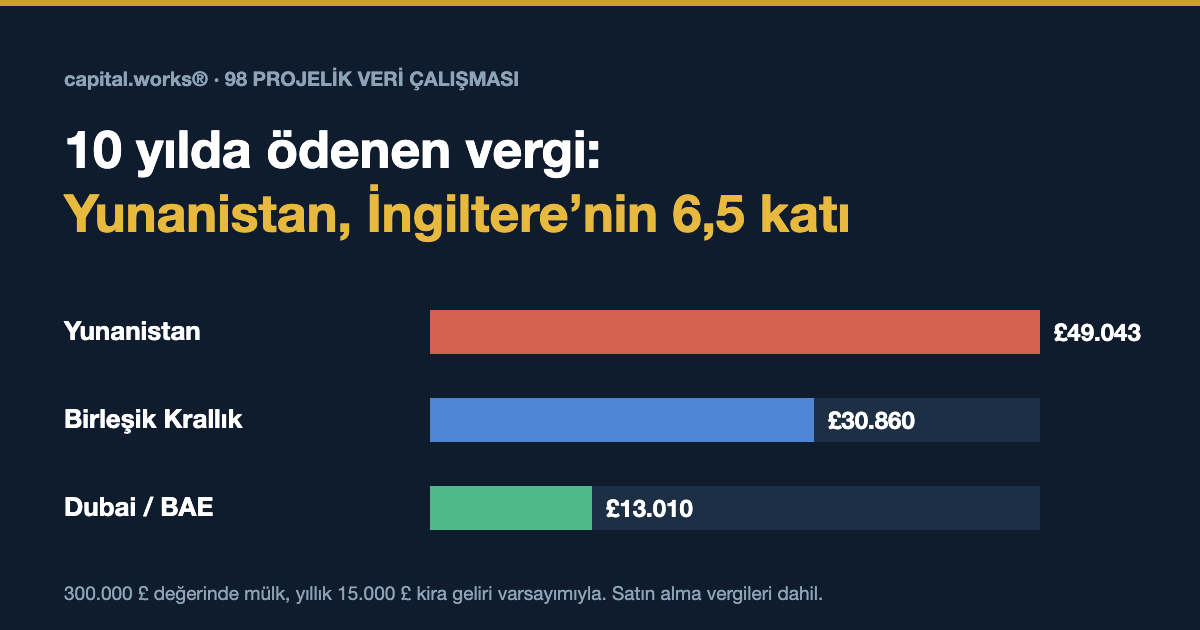
A buyer who builds a budget on the advertised price is caught unprepared at completion. Buying property abroad adds a meaningful percentage on top of the price in both markets.
England
Stamp duty (SDLT) is calculated in bands: zero up to £125,000, 2% between £125,001 and £250,000, 5% between £250,001 and £925,000. On top of that two surcharges can apply: for those who own more than one home, 5%, and for those not resident in the United Kingdom a further 2%. Both apply to the whole of the consideration.
| A £400,000 second home, a buyer resident overseas | Amount |
|---|---|
| Kademeli SDLT | 10.000 £ |
| The additional dwelling surcharge (5%) | 20.000 £ |
| The non-resident surcharge (2%) | 8.000 £ |
| Toplam damga vergisi | 38.000 £ |
So about 9.5% of the price, plus the solicitor’s fee, the title and environmental searches, the valuation and, if there is one, the loan arrangement fee.
Dubai
The Dubai Land Department (DLD) transfer fee is 4%of the consideration and by market convention the buyer pays it. On top of that, on properties of AED 500,000 and above there is a trustee office fee of AED 4,200, a title issue charge of AED 580 for an apartment, an agency commission usually of 2% plus VAT, and if you take a loan a registration fee of 0.25% of the loan amount. On an apartment of AED 1,500,000 these items exceed AED 95,000 in total.
The rates are as at August 2026 and can change. Confirm the current figure before making an offer; we can work the calculation out together for your own transaction.
3. Have you clarified the financing up front?
A reservation fee is often non-refundable. The loan approval should not be planned around the purchase; the purchase should be planned around the loan approval. In England the pool of banks lending to people resident overseas is narrower; on buy-to-let purchases the assessment looks not at your salary but at the rental performance of the property, and the maximum loan to value is usually kept lower. In Dubai the loan to value for non-resident buyers is a step lower still.
The currency your income is in also affects the bank’s decision. If you own a business, options beyond a residential mortgage such as a bridging loan, development and project finance can come into play as well. We compared them on our finance page .
4. What is the legal structure of the property?
Two apartments at the same price can be legally very different things.
England: freehold or leasehold?
Apartments are mostly leasehold. What you need to look at: the remaining lease term, the annual ground rent, the service charge amount and the curve of increases over the last five years, planned major works and the building facade documents. When the remaining term falls below 80 years the cost of an extension rises markedly and some banks will not lend.
Dubai: freehold areas and the status of the scheme
Foreign buyers can acquire property in designated freehold areas. On off-plan purchases confirm that the payments go not into the developer’s pocket but into an escrow account , that the scheme is registered with RERA and that your contract is recorded in the Oqood system. The developer’s past delivery record tells you more than the image in the brochure.
5. Is your return calculation gross or net?
The return quoted in advertisements is almost always gross: the annual rent divided by the price. The net return is what remains after deducting these:
- The service charge and the ground rent
- The management fee
- The void period; assuming two to four weeks a year is realistic
- Insurance, maintenance and periodic renewal
- In England, tax on the rental income; there is a separate registration regime for landlords resident overseas and if there is no registration the agent applies withholding
An apartment that appears to give 6% gross easily falls to the 3.5 to 4% band after these items. On the Dubai side there is no tax on rental income, but the service charge per square metre can be high and the cooling charge is billed separately.
If you are buying a property that needs work, put the refurbishment budget into the calculation from day one; on the refurbishment side we work out the cost and the timetable together with you.
6. Who is doing the due diligence, and what does it cover?
The seller’s or the developer’s adviser does not carry out due diligence on your behalf. In England, work with an independent solicitor : the title register, the local authority and utility searches, the energy performance certificate and a survey at a level appropriate to the age of the building. In older building stock the lowest level of report is often inadequate.
In Dubai verify the title record through the DLD, see the scheme’s RERA registration and its percentage of completion, and ask the building management for the service charge history. In both markets the rule is the same: see the document before you pay the money.
7. What is your exit plan?
Being able to sell is as much part of the plan as buying property abroad. Clarify these from the outset: how long on average it would take you to sell the property, which set of buyers you would sell to, whether your loan has an early repayment charge, and what the tax liability on sale would be. In England there is a 60 day period for reporting and payment on the sale of a home by someone resident overseas; the report is made even if no tax is due. In Dubai there is no capital gains tax, but transferring an off-plan property can require the developer’s consent and a certain percentage of payment.
And there is currency. If your income is in a currency other than sterling or the dirham, the result measured in your own money changes even if the value of the property does not.
A quick checklist for buying property abroad
- I have written the aim of the purchase in a single sentence
- I have calculated the total cost including taxes and fees
- I have a loan in principle and I know the maximum amount
- Freehold or leasehold, the remaining term and the service charge are known
- I have calculated the net return together with voids and costs
- I have an independent solicitor and the scope of the due diligence is set
- I have discussed the sale scenario, the tax reporting and the currency effect
Frequently asked
Does Buying a Home in the UK Give You Residence?
No. Buying a home does not create a visa or a right of residence in the United Kingdom. Residence is established through a separate application route and can be planned alongside a property purchase, but one does not take the place of the other.
Can I get a mortgage as a foreign national?
On suitable profiles, yes. In England there is a narrower pool of banks lending to people resident overseas; on buy-to-let purchases the assessment looks not at salary but at the rental performance of the property. In Dubai the maximum loan to value for non-resident buyers is usually lower.
Can I manage the process from the country I am in?
Yes. The reservation, the loan application, the coordination with the solicitor and the handover steps can all be carried out remotely. Where a signature is required a power of attorney is used.
Let us answer these seven questions together
If you are ready to buy property abroad, share your budget and your goal briefly; we will set out the options that suit you on the England and Dubai side and the table of total cost. The first conversation is for you to get information and creates no commitment.
Request a free initial assessment ya da browse the schemes on our list.
capital.works is a trading name of YATIRIM UK LIMITED and an FCA authorised credit broker in the United Kingdom. This article is for general information; it is not personal investment, legal or tax advice. The tax and fee rates are given as at August 2026 and can change. Consult an authorised adviser for your own situation.
Answers to the most common questions on this topic: Can You Buy Property in Dubai in Instalments? How Payment Plans Work